

When the Doom Guy Goes Witch-Hunting
Competing with popular high-octane action roguelikes is not easy. Equally difficult is turning an often revisited historical scenario, such as the Salem Witch Trials, into an interesting world concept. So when we heard that a small developer team like The Astronauts was working on a game that addressed both of those challenges, we had to see for ourselves.
So, how does Witchfire stack up against the competition? Is the world interesting and attractive enough to be worth exploring? Is the combat visceral and satisfying enough to keep players hooked? Is the gameplay engaging enough to turn endless loops into stepping stones towards something more? We’ll be tackling all this and much more in this review.
Please note that this review only refers to the early access version of Witchfire at the time of writing and may not reflect the finished game.
Article Summary
- Witchfire is an Apocalyptic FPS Action RPG with Roguelike and Extraction Shooter Elements
- This title offers gorgeous visuals, stellar action, and an exhaustive system of upgrades and abilities to customize the player’s character.
- Though the difficulty and repetitive loop may turn some players off, Witchfire is an impressive and underrated title with lots to offer fans of the Action RPG genre.
Story and Concept

We aren’t given a specific date for the events of the game, but judging by the environments and the events leading up to the start of the game, our best bet is that Witchfire takes place at some point between The Crusades and the Salem Witch Trials. In this alternate history, magic is a very powerful and very dangerous reality. By some unrevealed means, some witches, in particular, have attained devastating, almost godlike power.
Wielding power over life and death, these witches have laid waste to most of the world, leaving humanity on the brink of extinction or total subservience to malevolent and wrathful beings. In an act of great desperation, the Church, the one force still willing to oppose the witches, summons us to hunt these monsters. Our mission is to locate an artifact sought by a witch of calamity, hoping that we can harness its power for good before the darkness claims it.

We are a Preyer, a magically and perhaps demonically enhanced witch hunter. Physically, we are far above the average human, with a semi-immortal body that can be reformed should we fall in battle. We’ve been given the authority to defeat the Witch by whatever means necessary, so not only do we have full access to the Church’s arsenal of divine weapons, but we can also wield powerful spells and mystical artifacts.
The true mystery of the preyers remains hidden behind their silver masks. Forged by enslaved witches, nobody knows whether these masks are meant to hide a hideous visage, act as a badge of papal authority, restrain the Preyer’s true demonic power, or serve some other, darker purpose. Needless to say, there’s still a lot we, as the players, don’t know about the Preyers and their origins.
Aside from the opening, Witchfire is not a narrative-heavy game by any means. At first, a few notes will be scattered here and there in the hub. Still, before long, players will find all story elements solely through environmental storytelling or the descriptions of various weapons and items.
That isn’t to say the story of Witchfire is unsatisfying, but players looking to uncover the game’s vault of dark fantasy lore will need to pay special attention to their surroundings and any new items they come across. The world-building is very immersive, though not exceptionally expansive for now.
Graphics

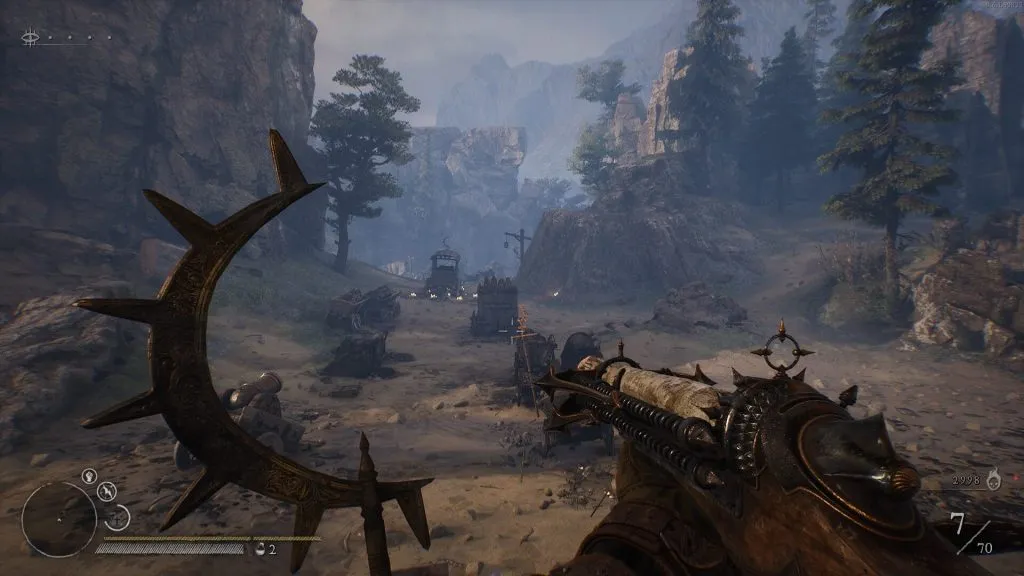
Our battles against the Witch’s minions are tense and brutal, but that certainly doesn’t mean we’ll be stuck battling through dreary daub corridors. So far, we’ve only seen a few of Witchfire’s planned maps, but each is stunning and delightfully unique with its own thematic and story elements.
It’s always nice to find a game that keeps us locked in from moment to moment, but here, we almost wished things would slow down so we could take a few moments longer to admire the fantastic scenery. The weather and time of day will shift, with rain and gales approaching as the Witch becomes aware of our presence. Twisting shafts of light gleam off forgotten weapons, littering a crimson coastline, verdant moss clings to crumbling castle ruins, and threatening shadows stalk the darkened halls of forgotten vaults.

There is something to see everywhere you look in Witchfire, whether it’s a bit of environmental storytelling, a secret passage or hidden treasure, or even just a beautiful vista warped by the Witch’s dark magic. The developers certainly didn’t slack off regarding the game’s many enemy types. From the grinning skeletons in gleaming armor to the bloated demons floating through the air and hordes of the vengeful dead are all waiting to put an end to our expedition.
There always seems to be a surprise or two hidden up our foe’s sleeve, but though the enemies all look excellent and are expertly animated, there is a lack of variety between the models. Most enemies are some variation of a skeleton or zombie, just with different outfits and weapons. What’s more, enemies of similar varieties, such as Grenadiers and Handgunners, often share assets.

As for weapon models and visual effects, we were completely blown away by the level of detail in this title. Each of Witchfire’s MANY weapons has its own visual style and unique elements that visibly react to its special ability. For example, Hypnosis is a rifle with a magic prism that illuminates as it charges a shot. At the same time, Hunger is a hand cannon that sports glowing cartridges when empowered with critical hits.
Combining these awesome details with the impressive visual effects of fire, frost, and lightning spells turns the battlefield into a wash of frantic gunfire and epic displays of arcane power. It’s easy to get lost in it all, but dominating this bullet hell with our own shows of witchcraft and clever weapons is supremely satisfying.
Sound and Atmosphere

If we had to relate the general atmosphere of this game to another popular IP, we’d say Warhammer Fantasy is the best general comparison. Warhammer has players envisioning colossal cathedrals, inquisitors in leather trench coats, and dark dungeons twisted by foul magic. The air of Witchfire is rife with such magics, so the air that encapsulates us during exploration is one of great devastation and ever-present danger but also quiet wonder at the beauty of these dangerous powers.
The game’s soundtrack is right on the money, with a mix of dark choirs and sinister chants backing up cinematic orchestral tracks or epic battle music. Though this isn’t the most inventive example we’ve heard, Witchfire’s music is textbook dark fantasy and ties a nice little bow on all the vicious running and gunning.

Each map has its theme and accompanying music, both in and out of combat. Additionally, certain bosses and events will incorporate their unique theme music. We never got tired of this game’s soundtrack, and the music and background ambiance blend seamlessly with no awkward loops or stutters.
The impressive palette of sound effects keeps combat exciting and exploration interesting. Puzzles and treasures will hum with magical power, dangerous but invisible Witch totems will rattle with attached bones, and the numerous enemies all clank and clatter in their heavy armor. Between all of this and the unique sounds of each spell and weapon, the auditory effects in this title are top-of-the-line stuff that makes it all the more addicting.
Gameplay

When it comes down to brass tacks, Witchfire is a Roguelike FPS RPG, so let’s break down each of those genres within the game’s systems one by one. The roguelike element means every expedition into the Witch’s territory is a separate run. When players begin a run, they choose which of the game’s maps to explore and set out, typically with the goal of either gathering loot or completing a specific quest.
The map will be randomized slightly each time, but the enemies and defenses will shift completely each time the player levels up. Groups of enemies, loot, puzzles, events, supply chests, and portals will be scattered around. Only enemies and certain loot types will initially appear on the player’s map.
For roguelike elements, these portals serve as our way out of each level, acting as an extraction point; most portals must be cleared of enemies and defended long enough to open. A few dormant portals are scattered around that serve as quick extractions, but these are much less common and don’t spawn enemies to hunt down the player.

Escaping through a portal is the only way to keep the loot found on an expedition, and if a Preyer dies in battle, they will drop all of their Volatile Witchfire, which is used to level up, as well as any collected treasure and special items such as keys at the site of their death. These riches can be recovered if the player reaches their remains before perishing a second time.
Moving on to the game’s FPS elements, much of the actual gameplay in Witchfire is centered around frantic shooter combat. Preyers can equip themselves with two weapons and one demonic weapon, which utilize different ammo types that the player can scavenge from ammo chests and defeated enemies around the map. With each group of enemies the Preyer defeats on an expedition, they will steadily grow stronger, gaining run-wide buffs by absorbing Arcanum Incarnations. These are randomized bonuses that offer a wide variety of effects.
Arcanum Incarnations can range from basic improvements like increased health or stamina to more specific augments like increasing the number of lightning bolts from spells. What’s even better, these effects will never be something the player just can’t use. For example, you will never be offered a buff to fire damage when you have no fire spells, which makes each incarnation useful and worthwhile.

Not all loot is safe, however, and in addition to the mind-bending puzzles and dangerous traps left behind by the Witch, there are also cursed items the player can pick up. These earn us gold upon a safe return but may alert the Witch to our presence. The Witch’s alertness meter will slowly fill each run as we take heavy damage, trigger curses, or make mistakes. If it fills completely, the Witch will block our escape and cast a deadly calamity hex. This spell can be stopped by locating and destroying the catalyst or defeated head-on, but surviving this curse (though very rewarding) is never easy.
Each time the player escapes with their loot, they are returned to the Hermitorium, a solitary island refuge where Preyers can spend Witchfire to level up and increase their stats. There isn’t much variety to these stats, but some may prefer to specialize in mobility and magic or boost their health and luck to be more survivable.
For how large the Preyer is, they’re remarkably nimble, capable of leaping, dashing, and sliding around the battlefield to avoid enemy attacks. Moves like these will cost stamina, however, so keeping an eye on this and your health and magic recharge times is vital. Otherwise, you could end up miscasting spells, which will cost you time or struggle to escape a charging foe when your breath gives out.

All enemies have weak points and armored points, as well as soul sigils that can be revealed and destroyed when dashing at full stamina. Shooting a weak point will deal a critical hit, causing much more damage and triggering associated effects from gear or spells. Destroying an enemy’s soul sigil will temporarily stun them, leaving them vulnerable to follow-up attacks, especially those from melee.
Yes, we do have a melee attack as well, but it will need time to recharge after use. Additionally, we have access to spells with wildly varying effects. There are TONS of ways to personalize your abilities and combat style. If you like slow and steady, critical effects and decay powers blend well with sniper rifles and hand cannons. If you’d rather get up close and personal, fire effects and shotguns leave enemies vulnerable to melee attacks.
This is a relatively difficult game overall, and fans of Soulslike games will probably be more accustomed to the death loop than typical roguelike fans. That said, the challenge grows steadily and only as the player is ready to confront it. Our Gnosis serves both as our level of magical knowledge and the game’s difficulty. Progressing to the next Gnosis level will require the completion of certain tasks but will allow access to new areas and much more dangerous threats.
Replay value

Frankly, Witchfire is a highly replayable title due to its roguelike gameplay loop. Some may find the repetition a bit tedious since the maps themselves won’t change dramatically, but the threats shift with each run, and new enemies, secrets, and tons more are constantly unlocking as we progress. However, the greatest returning draw for this game is easily the loadout customization.
Every weapon, spell, and piece of gear has its gimmick AND an upgrade system for those effects called mysterium. This system rewards players for using that item and completing its associated quests by unlocking new abilities and improving the item or spell’s overall power. Researching and experimenting with new gear is a ton of fun, but doing any of this requires witchfire and gold, both of which can only be found on expeditions.

Not only do the maps and enemies constantly evolve, but so do our arsenal and abilities. It’s engaging, addictive, and wonderfully unique.
Final thoughts on Witchfire (Early Access)

Witchfire is a remarkable mix of both gameplay and artistic styles. This is an impressive piece of work, from its ominous dark fantasy vibes to its power fantasy combat systems. Witchfire won’t be for everyone, of course. Its difficulty is apparent from the beginning, and getting started can be especially difficult for players unfamiliar with action RPGs. Those looking for a strong narrative may also be disappointed with the vague and mysterious environment this game cultivates.
That said, this title offers an addicting loop with a vicious and pulse-pounding combat system. Tie all that up with the gorgeous environments and myriad ways to customize your loadout, and we’re sold. Fans of recent Doom titles and action-based RPGs would be doing themselves a disservice not to give this one a look.
