
What is RUST Livestock Husbandry?
In RUST, Livestock Husbandry is an optional game progression subsystem introduced in the October 2026 update. Like other passive systems such as fishing and beekeeping, developing an animal farm leans more toward the PVE side, letting players collect new consumables in addition to the already complex Advanced Cooking System.
To understand Livestock farming mechanics, let’s look at each component individually and how everything comes together to provide the best possible environment for the new animals you add.
Livestock Husbandry Components
Players need only a handful of essentials to begin their own Livestock farm. While each item is detailed further in our RUST Item Database, here’s a brief overview below.
Animal Fencing and Gates
The Animal Fence and Animal Fence Gate are player-crafted, deployable structures that serve as the actual home for the Livestock Husbandry system. They are smaller partitions, similar to High External Walls and Gates, that keep hostile animals out and your livestock in.
Both are tier 1 blueprints and must be learned before you can craft them, but once you know them, they don’t require a workbench. You must have building privilege to place these constructs, and they follow the same decay structure as similar walls. They don’t currently contribute to base upkeep like other walls, but that is likely to change soon.
Space is another consideration you’ll want to think through before you start placing these fences willy-nilly. You can’t currently pick them up, so you have to break down and remake anything you place incorrectly. Animals will try to walk through cracks and crevices that you leave, so they need to be semi-tight-fitting with no body-wide holes. We haven’t gotten into it yet, but later in the article we’ll discuss animal Personal Space as a statistic.
Still in the realm of spreading out, the last couple of considerations are grass availability as a free food source (otherwise you’ll be placing and constantly filling Hitch & Troughs). Plan to have lots of grass or room for feeders.
Hitch and Trough, Grass, Water
It might seem a bit weird to include these as components, but without them you won’t be a very successful farmer. This is, of course, the same Hitch & Trough we’ve had in-game for several years now, used to great effect in the horse farm business. The only difference now is that it has a side compartment for 5000 mL of water, and you can attach the Industrial System to keep it topped off.
Grass doesn’t appear to be displaced or vanish when livestock eat it, but several server convars suggest areas can become overgrazed, including a stat item we will touch on later. Water was an issue in our early testing until we built next to a river and physically dipped some of the fencing down into the water. The animals didn’t really go near the river, but for whatever reason, their hydration stayed high.
Livestock
Each animal that you have operates as its own harvestable entity, and the welfare or statistics of one Livestock are independent of the others with minor nuances. When a new calf or lamb is born, their statistics and name are mostly random. Names are often an indicator of adult sexual orientation, but some are more unisex in name, leaving you to not know until the time they grow into Sheep, Cows, or Bulls.
Which leads us to the animals themselves.
Cow
Grown from a Calf. Matriarchal animal, protective of calves it has birthed. Mostly docile creatures while not actively raising offspring.
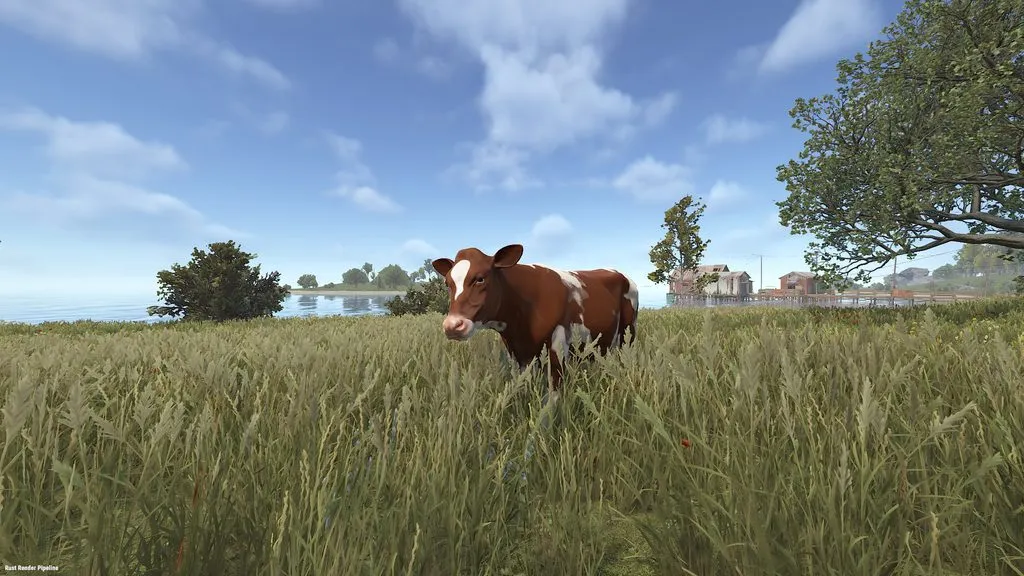
Outputs:
- Milk (1-2) when applicable, gained by looking at a familiar Cow’s udder area and pressing Milk. There’s a sub-5-minute cooldown on milking but no definitive convar.
- Killing and skinning yields 20 Raw Beef Meat, 30 Cloth, 100 Bone Fragments, 40 Animal Fat, 100 Leather.
Bull
Grown from a Calf. Patriarchal animal, protective of the herd and much less trusting than Cows. Actively warns and attacks any individual not recognized as friendly by the herd. Will kill anyone who harms any member of a herd to which it belongs.
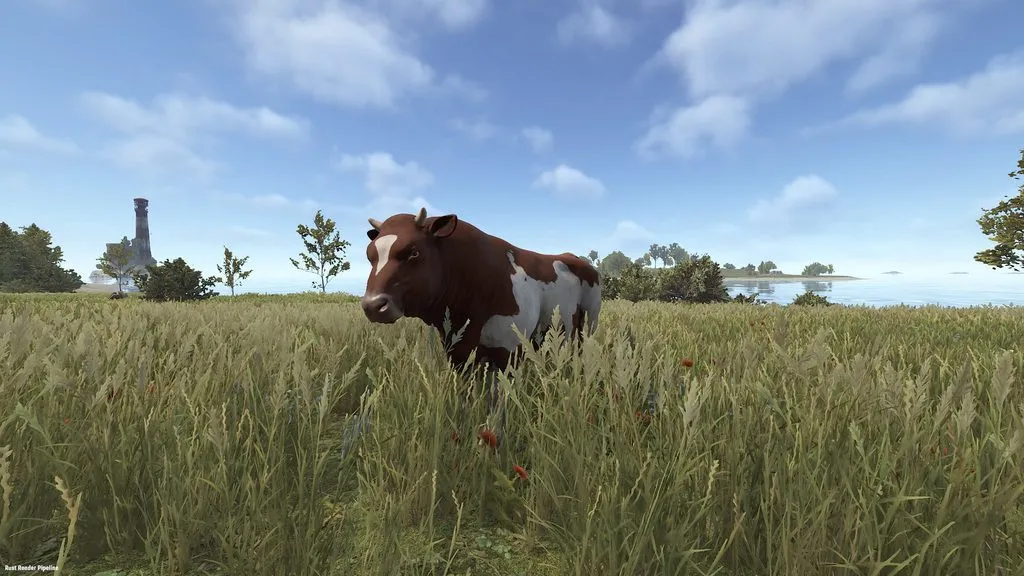
Outputs:
- Killing and skinning yields 20 Raw Beef Meat, 30 Cloth, 100 Bone Fragments, 40 Animal Fat, 100 Leather.
Calf
Cute and cuddly, mostly unisex for the purposes of a guide, curious, and tends to wander off.
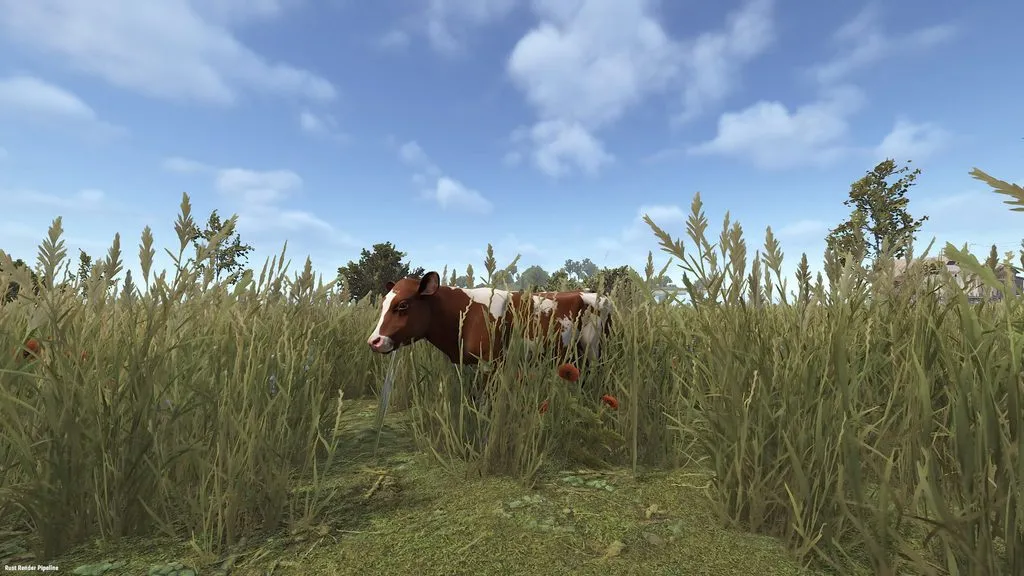
Outputs:
- Killing and skinning yield 20 Raw Beef Meat, 30 Cloth, 100 Bone Fragments, 40 Animal Fat, and 100 Leather.
Sheep
If horned, it acts like a smaller bull with a worse attitude. The females are a bit nicer.
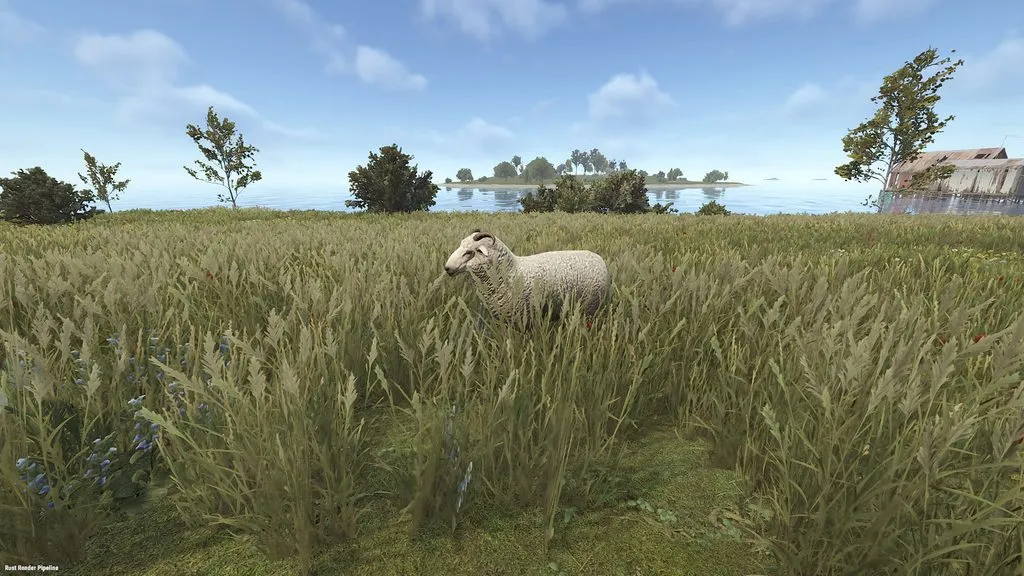
Outputs:
- May be hit with a skinning knife-type item in areas where Wool is evident, one time per segment, for currently indeterminate Wool output (ranging between 5-30 right now, highly WIP).
- Killing and skinning yield 12 Raw Mutton Meat, 10 Cloth, 50 Bone Fragments, 20 Animal Fat, and 20 Leather.
Lamb
Cute and cuddly, mostly unisex for the purposes of a guide, curious, and tends to wander off.
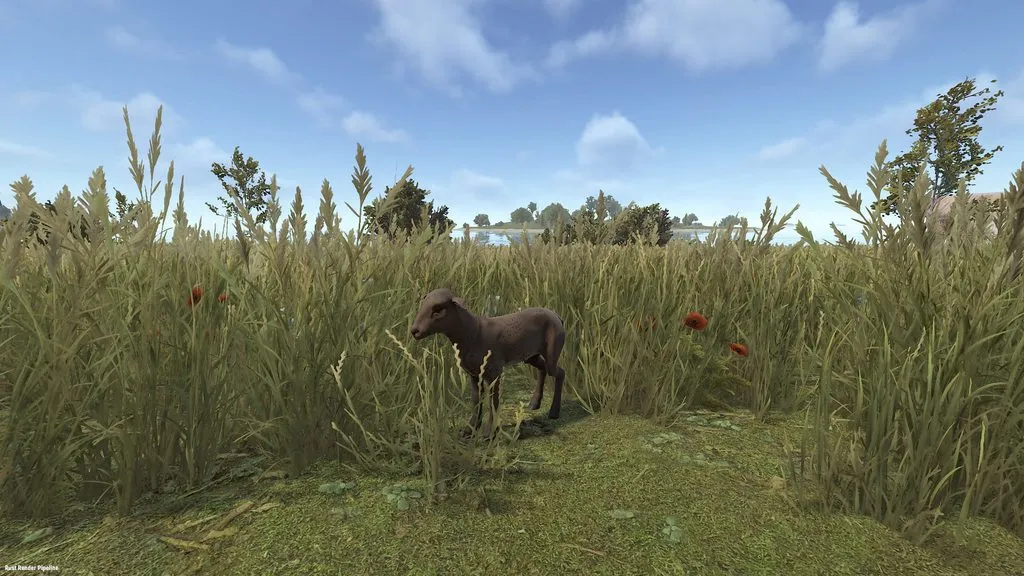
Outputs:
- Also semi-fleecable, but this animal isn’t finished yet. When killed and you attempt to skin it, the corpse disappears.
Livestock Statistics
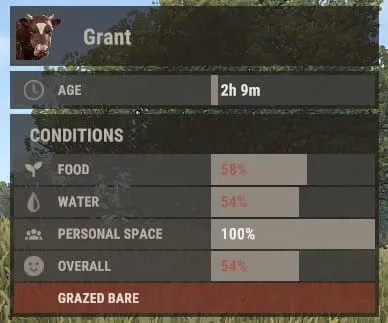
Like Bees and Chickens, these new livestock forms have their own preconditions. It might be best to go through these line by line. In earlier iterations of staging, the animals had things like genetics (yes, just like plants), but that seems to have temporarily disappeared, even though the convars remain.
- Name – Each cow, bull, sheep, whatever, is born with a name that cannot currently be altered. If a calf or lamb is bred and born (as opposed to just spawning), they are often named as a derivative of their father’s or mother’s name, i.e., Grant Junior for the immediate heir, or the 3rd, and so on.
- Age – Hit or miss right now. Sometimes it cites a relatively logical, hour-based age for your Animal. The tick rate doesn’t increase correctly; some animals stay at 0 hours old, even after days on the server. Work in Progress. According to backend information, age should eventually be the metric Livestock Vendors use to make offers, with animals in their Prime bringing the most profit and those near the end of their lives being worth less.
- Food – These animals can graze naturally and eat to survive. The exact way the grass replenishes itself is unknown. They will also eat from nearby Hitch & Troughs, which have also recently been given a smaller, segregated water section. On staging, at least for now, without using a fulling convar, keeping them at 100% food and hydration is nearly impossible.
- Water – Same as food, water doesn’t go down nearly as fast or consistently as food. In our testing, we built our livestock pen slightly into a river and never had any trouble keeping this level at 60% or higher.
- Personal Space – Ironically, this stat has little to do with the overall size of the area you designate with fencing for your animals. It is about how stacked the animals are when trying to feed or mate, which at the moment seems a bit broken. You can set up different troughs at varying distances, and it almost seems like the AI goes out of its way to stack on top of one another.
- Overall – Represented exclusively by the lowest % number of any of the other 3. Doesn’t matter if everything is 100% except one that’s 5%; this will set the overall to 5%, so it isn’t an average
- Grazed Bare – An animal with this listed at the bottom of their stats window indicates that there is no grass for it to eat, despite the appearance of such. This animal requires third-party food, IE a trough with any sort of vegetable inserted.
Food
Livestock can eat any of the following foods:
- Apple
- Black Berry (admin only)
- Black Raspberries
- Blueberries
- Blue Berry
- Bread Loaf
- Brioche Bread
- Corn
- Granola Bar
- Green Berry
- Grub
- Potato
- Pumpkin
- Red Berry
- Wheat
- White Berry
- Worm
- Yellow Berry
No, you can’t make livestock go full carnivore, and despite our best efforts, we could not coax them to go cannibal, either. You live, you learn. We even tested Coconuts, but they refused to sample.
Genetic Anatomy
All livestock animals have genetic characteristics that make them unique, to a point. An animal can only have so many iterations, but still quite a few.
Green intuitively denotes positive or less negative than red. Grey is the middle ground, neither positive nor negative, and of course Red is bad. Each genetic letter has its own meaning and affects either yield or raising the animal. These meanings are;
| Genetics / Physical Appearance Links | Red (~8m Consumable, ~17m Dung Cooldown) | Grey (~5m Consumable, ~10m Dung Cooldown) | Green (~3-4m Consumable, ~6.5m Dung Cooldown) |
|---|---|---|---|
| D – Dung, Manifests in coat appearance. Black is bad, Brown is good. | ~4 per hour | ~6 per hour | ~10 per hour |
| L – Lifespan, Greater coat spotting typically means longer life. | ~32 Real World Hours | ~48 Real World Hours | ~72 Real World Hours |
| Y – Yield, Higher color cover equates to higher yields | 1 Milk / 6 Wool | 1 Milk / 10 Wool | 2 Milk / 16 Wool |
| F – Fertility (Cooldown / Size)Jagged fur promotes fertility; smoother equates to worse | ~1.5 Hours / 1 | ~1 Hour / 1 | ~45 minutes / 1-2 |
| H – Hardiness (level needed for ideal “full”, ready to breed condition). Thicker coat means higher hardiness | ~70% | ~50% | ~34% |
| Herd # | Numerical representation of the animals’ herd designation. To prevent inbreeding, segregate like-numbered animals and allow them to breed only with members of other Herds. | ||
Familiarity and Bonding
Unlike horses, livestock animals require a bonding period before they tolerate, listen to, and finally accept a player so they can be led. Shepherd and Rich Shepherd Pies help considerably. These are new items released with the same update as Livestock, and require the new Mutton Meat gained from fallen sheep to craft.
There are both Herd and Individual animal trust meters, even though you can’t currently see them. Attacking or hurting any one animal drops its trust in you a lot, and the rest of the herd’s trust in you a little. You gain familiarity by being around the animal, physically close. Give an animal at least 90 seconds before attempting to lead it. Bulls and male sheep will attack and attempt to kill those they don’t trust. If you are attacked, they will keep attacking until you run away and they break chase. You may then try again.
Familiarity is a definite work-in-progress metric, with convars that also imply newborn or bought calves and other livestock must integrate into the herd. Honestly, this system is constantly being added to, subtracted from, and altered; we’ll include every possible convar we can find at the bottom of the Livestock Guide for you to review. As it stands, the trust cap, determined by seconds spent around livestock to gain familiarity, is set to 960 seconds.
During the Staging phase, there were convars for Calmed Trust Floors, which is the number of seconds it takes before livestock animals credit a player and are considered under their handling. By default, this was a minute.
Some animals bred and born in captivity also start with what backend commands call Curious status, meaning 20% of them will follow known/familiar players without needing a lead at all.
Of course, this system includes penalties for players who ‘distress’ the herd by harming or killing a member. This manifests as actual negations of time spent with the herd, so they will go backward in the trust department. Bulls will return to being aggressive, Sheep will headbutt, and others will simply run away if you try to lead them. You have to restart the bonding process.
There are time convars that also imply animals harmed by players will avoid it for a period of time, currently set to 45 seconds. They will try to stay at least 8+ meters away.
Animals will also adapt and recognize your tool cupboard as home after a certain amount of time, and be more accepting of teammates authorized to the same entities as familiar players.
To be known to an animal, enough for it to follow you out of curiosity, you must be close for roughly 5 seconds. To keep angrier animals, such as bulls or mothers, from attacking you, you must be nearby for 30 seconds. Bonding takes a full 5 minutes, so you can lead the animal and milk it when available. To fully link with the herd, you must be around them for 15 minutes.
Calves born into a herd will share their birthmother’s familiarities.
Mating and Reproduction
Assuming you’re familiar with the basic tenets of real-world reproduction, I’ll limit what I disclose to this: the Cow takes the form of the Mother, and the Bull is the father. The same applies to Sheep: those with male names and horns are the Fathers, and those with feminine names and no horns are the Mothers.
Males of the species have a 600-second cooldown before they can do their part of the process. Cows may be bred with nearby Bulls, and female sheep with nearby males, indicated by the Pregnant label appearing in their stat info. By default, for breeding to occur, both animals must have a minimum Overall condition of (0.7), paused at (0.6) to mate. Younger animals are not included in this process, but once they reach adulthood, they can mate with any animal of the same species and opposite gender.
Once a Cow gives birth to a calf, she will not mate again until that calf has grown into an adult bull or cow. Sheep were restricted from reproducing during the Staging phase of testing.
Inbred status occurs when animals from the same herd and genealogy mate with one another. Animals can be found in the wild like this, purchased from a vendor like this, or simply be born this way after a few generations grow up and crossbreed. Inbred status shows up on the animal’s genetic readout and harms every aspect of its life.
There is inherent genetic weakening that won’t be as readily apparent. Conversely, some animals may be genetically perfect. These animals are especially rare, but you may breed them intentionally if you segregate your herd correctly over time.
Bedtime
Livestock will go to bed (i.e., lie down) where they were standing before the sun went down and go motionless at roughly 8:30 pm (env.time 20.5). They will wake up or resume regular motion just before 7:00 am (env.time 7). Exceptions exist, such as when a predator comes knocking and a Bull has to defend itself.
Transportation and Retention
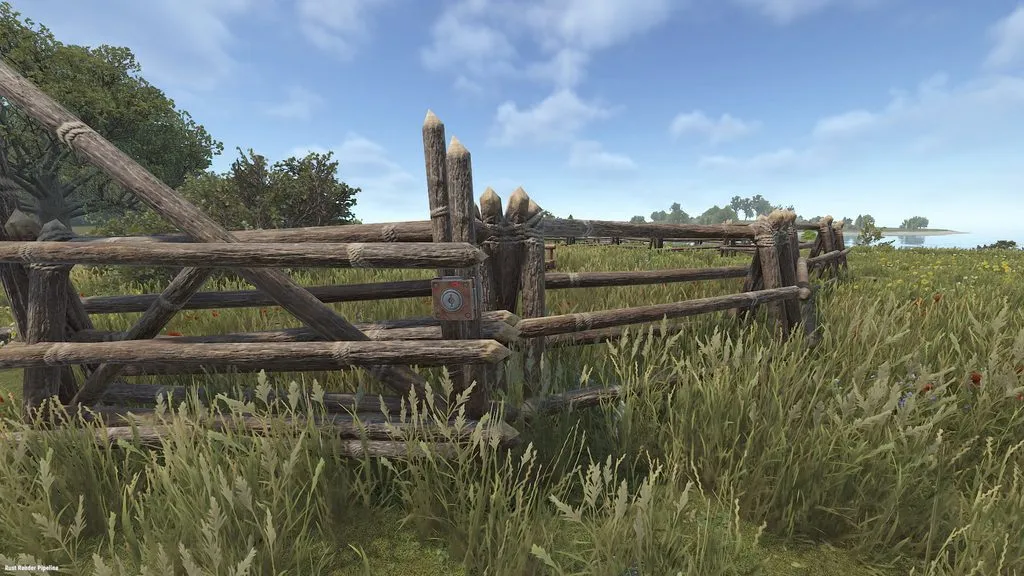
You’ve probably seen images of Animal Fencing and Gates, and if you haven’t, I know you’ve seen these sorta structures on the road in the real world. They are simple enough Tier 1 Workbench blueprints that use the same snapping and privilege rules as any other wall or barricade. They keep your animals in, and more importantly, other animals out. Wildlife like to attack livestock, and since they’re such a time and money investment, you better keep them secure.
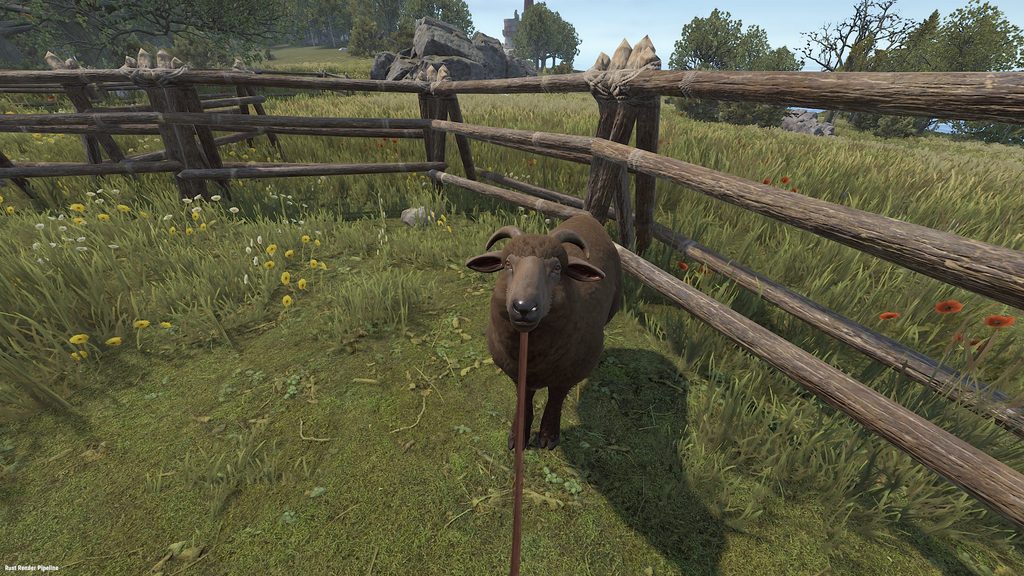
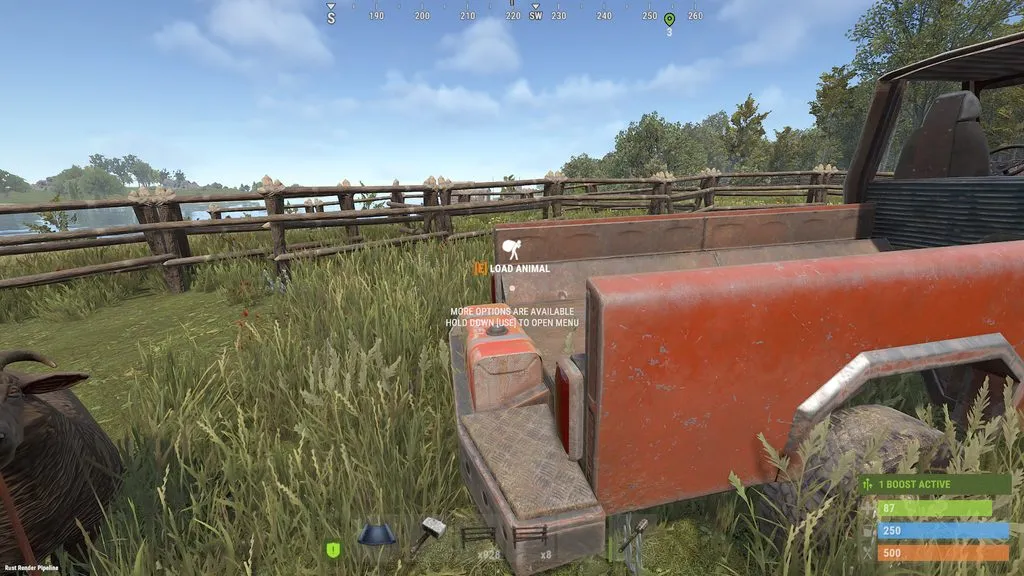
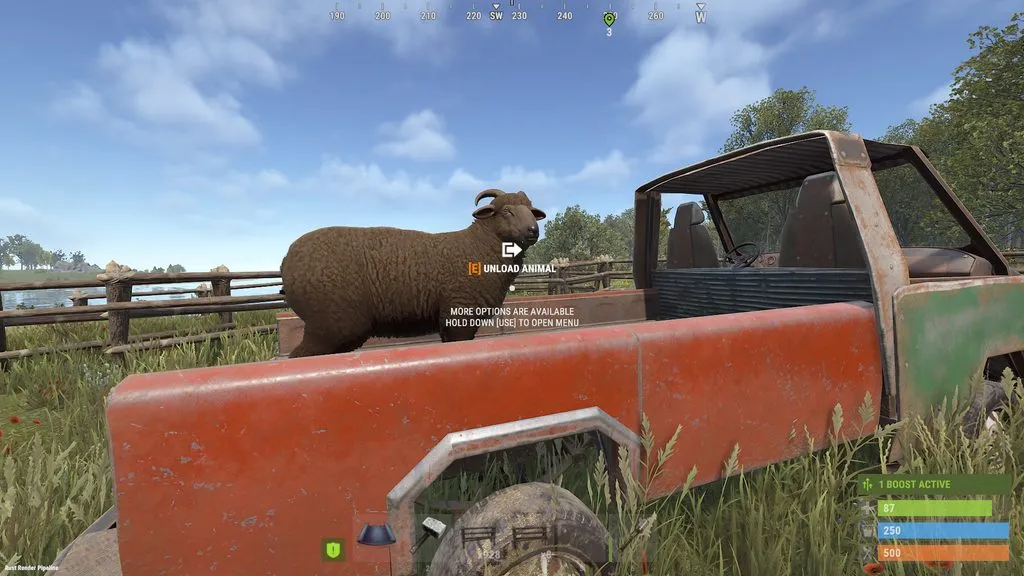
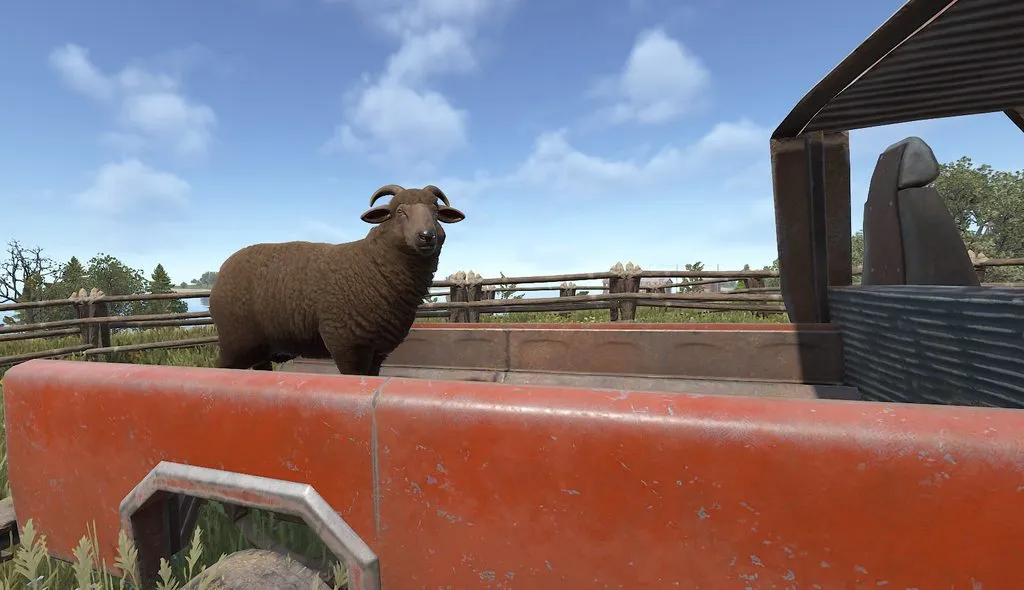
Of course, the usual method of leading an animal in Rust, such as a horse, still works for all the livestock mentioned above. This means approaching the animal once you’re familiar with it and simply leading it around. But in 2026, we have an alternate method. For once, the images properly map out how to do something, so I will let them speak for themselves. Yes, they really sit there as you whip around like a drunkard.
Home, Home on the Range…
Livestock of all sorts exist around the map, but only in specific locations. They tend to avoid places like the desert, snow, and jungle biomes, but you can bring them there, and they’ll live there. If it’s green and free of big cats, you’re likely to find them there. Wild animals enjoy forests, plains, and river areas. You will often find them in groups ranging from a single animal to 4-5.
Livestock Vendor
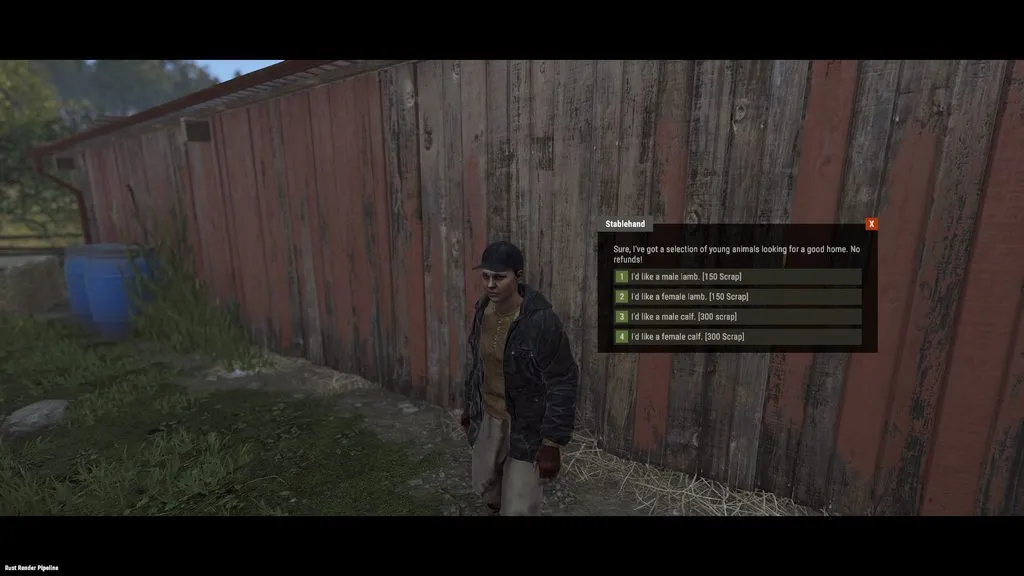
Instead of raising animals for meat and resources, you can raise them for trade. At each Ranch and Large Barn, a Stablehand/Livestock Vendor will be available. They will both sell you young animals and buy what you have. This is the only surefire way to get exactly the sex of animal you want. The crux is that you have to transport the animals to and from the market to make the transaction.
To sell an animal, you must actively lead it. You can deny the vendor’s offer twice, but a third time will make them not want that animal (or wool) for a while. What you are offered might vary a great deal per animal, or very little at all. It depends on how deep they go into genetics and rarity. Some convars point to ‘special’ animals.
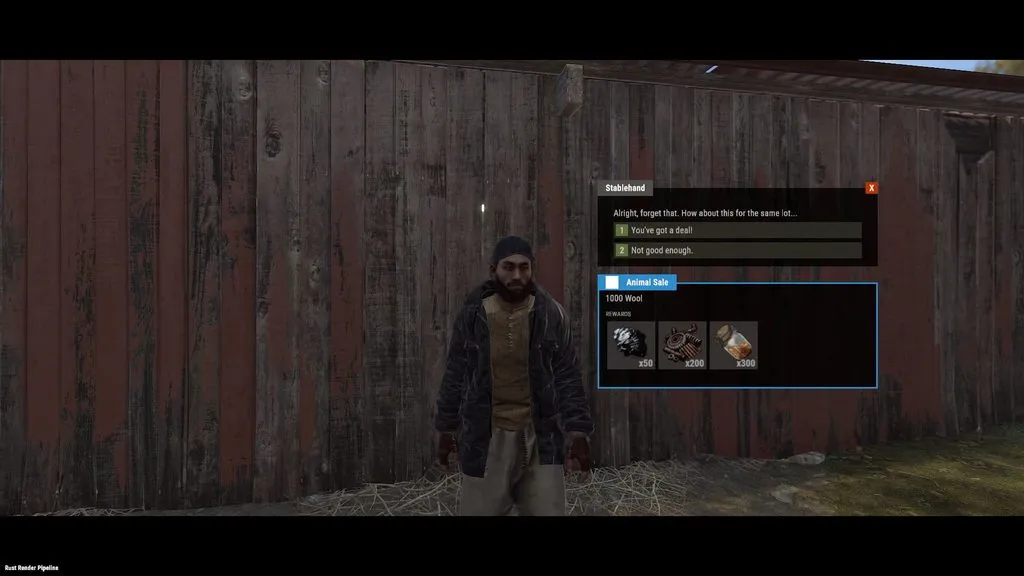
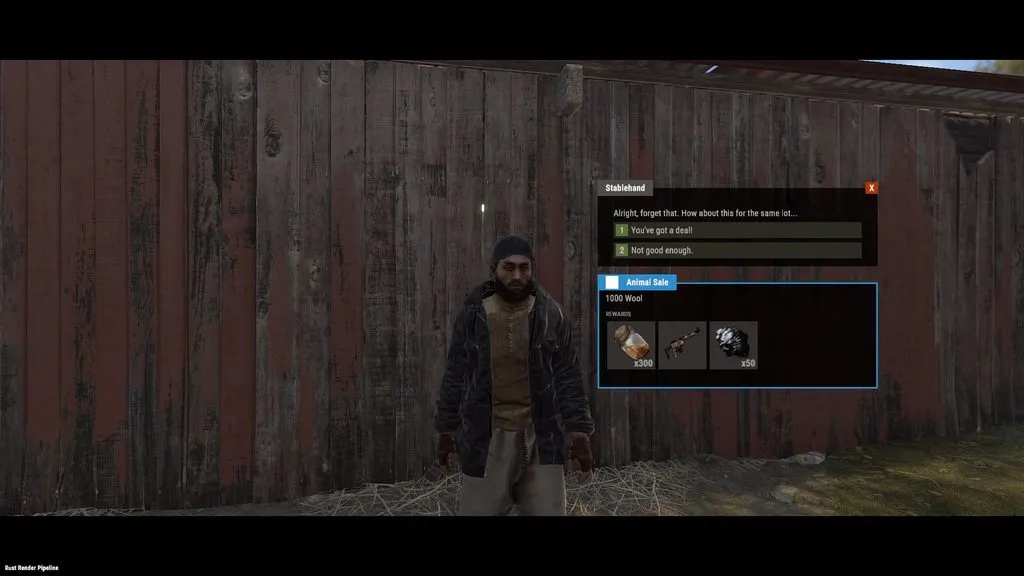
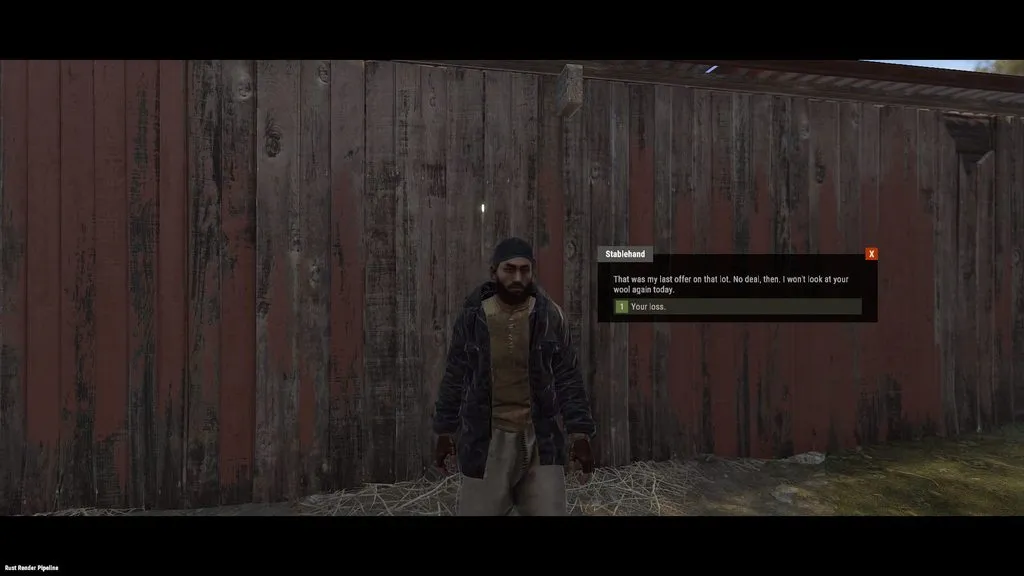
While we’re here, he will also buy your wool in bundles of 100-1000. The same 3-strike offer and no-deal rule apply.
If you do happen to see wild Cows or Bulls near a vendor, it might just be worth your time to lead them in for a quick buck.
Rehoming Livestock
Perhaps rehoming is the wrong word here, but if you’re looking to break a neighbor’s fence and coax his loyal animals onto your land, you’d be better off chopping them up and absconding with the resources you gather. Not saying this sort of business is impossible, but tool-cupboard-adjacent protections seem to be in place to stop easy cow theft.
All the Right Reasons
Like any other for-profit passive system, Livestock husbandry has benefits for every ounce of work put in. Without question, producing Raw Beef, Mutton Meat, and Wool as standalone resources would be enough to justify its existence, but with the new Cooking Workbench recipes, pie buffs, and the new Milky and Creamy teas, they’ll be hot ticket items for everyone. Clans will definitely raid for them. Plus, all the new animals provide passive Dung, just like horses.
How to Get Started with RUST Livestock Husbandry
The easiest way is to set up a proper holding area near a Large Barn or Ranch and buy one animal at a time. Ferry them to their new home, put in the work, and expand. We imagine this will be quite difficult on live servers once 1000 other people are trying to do the same thing. Time will tell.
Livestock Admin Commands & Convars
As with all systems added to RUST, convars let admins change things like timing, transfer rates, etc. Below are all in-game convars, many of which are strictly for quality assurance and testing.
| Variables | Description |
|---|---|
| livestock.agescale | Multiplier applied to livestock grow and old-age times; 0.5 = grow up twice as fast, 0 = disable aging entirely (1) |
| livestock.allowmounting | Whether livestock can be mounted into vehicle flatbeds (True) |
| livestock.baselinenameweight | How many notional players livestock.namelocale counts as when the languages of everyone connected are weighed up, so one player alone does not name the whole herd (5) |
| livestock.breedcooldown | How long (in seconds) a male livestock animal waits before breeding again, counted from conception. The female’s is derived from how long her calf takes to grow up (600) |
| livestock.breedingenabled | Whether livestock look for a mate on their own; disabling it leaves livestock.makepregnant working (True) |
| livestock.breedpausecondition | Condition at or below which a livestock animal stops being willing to breed (0.6) |
| livestock.breedresumecondition | Condition at or above which a livestock animal that stopped breeding is willing again (0.7) |
| livestock.breedsearchradius | How far (in metres) a male livestock animal looks for a mate (30) |
| livestock.calmedtrustfloor | The seconds a livestock animal credits to a player under a livestock handling effect; kept inside the tolerated band on purpose (60) |
| livestock.calvingcooldownscale | Scales how long a mother waits after calving before she can carry again. 1 is one calf grown up per birth (1) |
| livestock.conditionfallseconds | How many seconds a totally neglected livestock animal takes to go from full health to dead (3600) |
| livestock.conditionfullcontentment | Contentment at or above which a livestock animal is healthy and heals towards full (0.5) |
| livestock.conditionriseseconds | How many seconds a well kept livestock animal takes to heal from nothing back to full health (3600) |
| livestock.curiousbreakdistance | How far (in metres) a player can get before a curious livestock animal gives up following them (20) |
| livestock.curiouschance | The share of livestock born curious, so they follow a player they know without needing a lead; 0 disables curious animals (0.2) |
| livestock.curiousfamiliarityscale | How much faster a curious cow or calf builds familiarity than the rest of the herd (2) |
| livestock.debugcondition | Adds the condition and its breeding band to a livestock animal’s ai.showState read-out (False) |
| livestock.debugdaybudget | Adds the day budget shares to a livestock animal’s ai.showState read-out (False) |
| livestock.debuggait | Adds walk speed and gait penalty to a livestock animal’s ai.showState read-out (False) |
| livestock.debuggenes | Adds an animal’s genes to its ai.showState read-out (False) |
| livestock.debugovergrazing | Logs livestock overgrazing as it happens (False) |
| livestock.debugspecials | Logs each special livestock animal as it spawns (False) |
| livestock.defendreactiontime | How recently (in seconds) a player the herd counts as one of its own must have been attacked for a bull to come after whoever is doing it; 0 stops him defending players (5) |
| livestock.devnamechance | The chance a freshly named livestock animal is given a developer’s handle instead of an ordinary name; one named that way never founds a dynasty (0) |
| livestock.dungconditionfloor | Condition below which a livestock animal stops dunging at all. A starving animal never dungs whatever this says (0.15) |
| livestock.dungconditionfull | Condition at or above which a livestock animal dungs at its full authored rate (0.8) |
| livestock.dungslowestscale | How much longer a livestock animal at the condition floor waits between dung drops than one in its prime (3) |
| livestock.dynasticnames | Whether a newborn livestock animal takes its same-sex parent’s name one generation on, so a line reads Melk then Melk Junior then Melk the 3rd (True) |
| livestock.familiaritydistresspenalty | How many seconds of familiarity a player loses with the herd around an animal they hurt (30) |
| livestock.familiarityhurtpenalty | How many seconds of familiarity a player loses with a livestock animal they hurt (60) |
| livestock.familiarityradius | How close (in metres) a player has to be for a livestock animal to count the time; must sit inside the animal’s sense radius; 0 disables familiarity (20) |
| livestock.familiarityrate | Multiplies how fast livestock familiarity builds up; 20 makes a five minute bond take fifteen seconds. For testing, leave at 1 for play (1) |
| livestock.friskythreshold | How well met a livestock animal’s worst need must be (0-1) before it will canter about for the fun of it; above 1 disables it (0.85) |
| livestock.genebadchance | The chance each allele of a wild livestock animal is rolled Bad; the rest come out Ok (0.3) |
| livestock.genedungbad | How often a Bad Dung livestock animal drops dung, as a share of an average one (0.6) |
| livestock.genedunggood | How often a Good Dung livestock animal drops dung, as a multiple of an average one (1.6) |
| livestock.genefertilitybad | How often a Bad Fertility livestock animal breeds, as a share of an average one; litter size never falls below one (0.65) |
| livestock.genefertilitygood | How often a Good Fertility livestock animal breeds, and how many young it carries, as a multiple of an average one (1.6) |
| livestock.genegoodchance | The chance each allele of a wild livestock animal is rolled Good (0.2) |
| livestock.genehardinessbad | How well a Bad Hardiness livestock animal tolerates going short of food, water or room, as a share of an average one (0.7) |
| livestock.genehardinessgood | How well a Good Hardiness livestock animal tolerates going short of food, water or room, as a multiple of an average one (1.5) |
| livestock.genelongevitybad | How long a Bad Longevity livestock animal lives, as a share of an average one (0.65) |
| livestock.genelongevitygood | How long a Good Longevity livestock animal lives, as a multiple of an average one (1.5) |
| livestock.genemutationchance | The chance each inherited livestock allele is rerolled from scratch instead of coming from its parent; leaving this at 0 is what makes breeding predictable enough to reason about (0) |
| livestock.genesenabled | Whether livestock genes do anything; off makes every animal an average one without touching the genomes they carry (True) |
| livestock.geneyieldbad | How much milk or wool a Bad Yield livestock animal gives, as a share of an average one (0.6) |
| livestock.geneyieldgood | How much milk or wool a Good Yield livestock animal gives, as a multiple of an average one (1.6) |
| livestock.grazesuntilovergrazed | How many times livestock can graze one patch of grass before it is eaten bare (1) |
| livestock.grudgeduration | How long (in seconds) a livestock animal stays wary of a player that hurt it or one of its herd, moving off when they come close again; 0 disables grudges (45) |
| livestock.grudgerange | How close (in metres) a remembered aggressor has to get before a wary livestock animal moves off (8) |
| livestock.inbredscale | What every gene of an inbred livestock animal is multiplied by, where an animal is inbred when both its lineage markers match (0.7) |
| livestock.localenames | Whether livestock names follow the languages of whoever is connected; off names every animal from the English pool, as before the packs existed (True) |
| livestock.maxlittersize | The most young one livestock birth can ever produce, however good the mother’s Fertility is (3) |
| livestock.motherlyduration | How long (in seconds) a mother stands her ground for her own calf after something has threatened it, rather than running like any other cow; 0 disables maternal defence (300) |
| livestock.namelocale | The language livestock are named in when nobody connected speaks one the game has names for, and the language the baseline weight reinforces (en) |
| livestock.overgrazedareacooldownminutes | How long (in minutes) an overgrazed patch of grass takes to grow back (30) |
| livestock.overgrazedarearadius | How far (in metres) an overgrazed patch of grass reaches from its centre (5) |
| livestock.overgrazingenabled | Whether grass a herd has eaten bare stops feeding them until it grows back (True) |
| livestock.panelage | Whether a farm animal’s status panel says whether it is young or grown (True) |
| livestock.panelalleles | Whether both copies of every livestock gene are shown rather than only the one the animal expresses. Reveals what an animal carries without breeding it (True) |
| livestock.paneldung | Whether a farm animal’s status panel shows how often it dungs, after its genes (False) |
| livestock.panelgender | Whether the male and female symbols are shown next to a farm animal’s name on its status panel (False) |
| livestock.panelgenes | Whether the gene discs are shown on the livestock status panel, along with the inbred warning that explains them (False) |
| livestock.paneltrust | Whether a farm animal’s status panel shows how much it trusts you, as one segment per band of the trust ladder (False) |
| livestock.panelyield | Whether a farm animal’s status panel shows what it produces and how often, after its genes (False) |
| livestock.priceageprime | How far through its life a livestock animal stays worth its full price, from 0 in its prime to 1 at death by old age (0.5) |
| livestock.priceconditionfloor | Condition at or below which a livestock animal sells for the least a vendor will pay (0.15) |
| livestock.priceconditionfull | Condition at or above which a livestock animal sells for the vendor’s full price (0.8) |
| livestock.pricefullqualityscale | The livestock sale value that counts as full quality, which the vendor’s sale table bands are measured against (1.5) |
| livestock.pricegeneweight | How far a livestock animal’s genes move what a vendor pays, where 1 pays its full gene advantage and 0 prices every animal as an average one (1) |
| livestock.priceoldestscale | What a livestock animal at the very end of its life sells for, as a share of the vendor’s full price (0.5) |
| livestock.priceworstscale | What a livestock animal at the condition floor sells for, as a share of the vendor’s full price (0.4) |
| livestock.profile | Times how long livestock spend in their needs queue and FSM tick, for livestock.census. Off by default because the measurement itself costs (False) |
| livestock.specialchance | The chance each wild livestock spawn is one of the named special animals; births, purchases, age-ups and saves never roll for one (0.005) |
| livestock.trustcap | The most seconds of familiarity one player can bank with a livestock animal (960) |
| livestock.trustfloor | The seconds a livestock animal credits to the team, cupboard authed and door code sharers of anyone it is bonded with; kept inside the tolerated band on purpose (60) |
| livestock.trusttobond | How many seconds near a livestock animal before you can lead it, and before standing in your cupboard makes that its home (300) |
| livestock.trusttodefend | How many seconds near a livestock animal before a bull counts you as one of his herd and defends you (900) |
| livestock.trusttofollow | How many seconds near a livestock animal before a curious one follows you without a lead (5) |
| livestock.trusttotolerate | How many seconds near a livestock animal before a bull stops squaring up at you (30) |
| livestock.vendorannoyedtime | How many seconds a livestock vendor refuses to look at goods whose every offer was turned down (900) |
| livestock.vendorgenerouschance | The chance each livestock offer is a generous one, where the vendor pays for a better animal than the one in front of him; 0 disables it (0.05) |
| livestock.vendorgenerousmax | The most a generous livestock offer lifts an animal’s quality by (0.25) |
| livestock.vendorgenerousmin | The least a generous livestock offer lifts an animal’s quality by (0.1) |
| livestock.vendoroffercount | How many offers a livestock vendor makes for one animal before he is annoyed and stops buying (3) |
| livestock.vendorofferitems | How many different items a livestock vendor bundles into one offer (3) |
| livestock.vendoroffervariance | How far a livestock vendor’s offer can swing either side of what an animal is really worth (0.05) |
| livestock.vendorwoollotsize | How much wool counts as a full lot, which the vendor’s wool table bands are measured against (1000) |
| livestock.vendorwoolminimum | How much wool a player must be carrying before a livestock vendor will haggle over it at all (100) |
| Commands: | Description |
| livestock.ageup() | Immediately ages up the nearest livestock animal: an infant grows into its next stage, an adult dies of old age. Optional search radius in metres (default 20). |
| livestock.census() | Counts the livestock population and what it has produced. Optional radius in metres around the caller (default 0, the whole map). |
| livestock.censusreset() | Zeroes the livestock census running totals and the profiler, so the next reading covers only what happens from now. |
| livestock.cleargrazing() | Grows back every overgrazed patch of grass near the caller, and clears what the herd has eaten there. Optional radius in metres (default 100). |
| livestock.completepregnancy() | Makes the nearest pregnant livestock animal give birth now, without waiting out the rest of its pregnancy. Optional search radius in metres (default 20). |
| livestock.dung() | Makes the nearest livestock animal drop dung now, without waiting for its timer. Optional search radius in metres (default 20). |
| livestock.emptyfullness() | Empties the nearest livestock animal’s fullness, so it goes looking for food. Optional search radius in metres (default 20). |
| livestock.emptyhydration() | Empties the nearest livestock animal’s hydration, so it goes looking for water. Optional search radius in metres (default 20). |
| livestock.emptysocial() | Empties the nearest livestock animal’s social need, as if it had been on its own. Optional search radius in metres (default 20). |
| livestock.fillfullness() | Fills the nearest livestock animal’s fullness, as if it had just eaten its fill. Optional search radius in metres (default 20). |
| livestock.fillhydration() | Fills the nearest livestock animal’s hydration, as if it had just drunk its fill. Optional search radius in metres (default 20). |
| livestock.fillsocial() | Fills the nearest livestock animal’s social need, as if it were standing in a herd the right size. Optional search radius in metres (default 20). |
| livestock.forcebreed() | Makes the nearest livestock animal pregnant. Obeys standard breeding rules. Optional search radius in metres (default 20). |
| livestock.makepregnant() | Makes the nearest livestock animal pregnant. Obeys standard breeding rules. Optional search radius in metres (default 20). |
| livestock.overgrazehere() | Marks the grass where the caller is standing as overgrazed, without waiting for a herd to eat it. |
| livestock.readytomilk() | Makes the nearest cow ready to milk now, without waiting out its cooldown. Optional search radius in metres (default 20). |
| livestock.readytoshear() | Makes the nearest sheep ready to shear now, without waiting out its cooldown. Optional search radius in metres (default 20). |
| livestock.rename() | Renames the nearest livestock animal. Usage: livestock.rename <name> [radius], quoting a name that contains spaces, radius in metres (default 20) |
| livestock.sendhome() | Moves the wild anchor of every livestock animal in range to where the caller is standing, so roam and the night gather aim here. A cupboard still outranks it. Optional radius in metres (default 30). |
| livestock.setcondition() | Sets the condition of the livestock animal the caller is looking at, or the nearest one. Condition is the slow average that price, dung and willingness read. Usage: livestock.setcondition <0-1> [radius], radius in metres (default 20) |
| livestock.setcurious() | Makes the nearest livestock animal curious or not, so it will follow a player it knows without a lead. Usage: livestock.setcurious <0|1> [radius], radius in metres (default 20) |
| livestock.setfamiliarity() | Sets how many seconds of familiarity the calling player has with the livestock animal they are looking at, or the nearest one. Usage: livestock.setfamiliarity <seconds> [radius], radius in metres (default 20) |
| livestock.setfamiliarityall() | Sets how many seconds of familiarity the calling player has with every livestock animal in range. 0 resets them all. Usage: livestock.setfamiliarityall <seconds> [radius], radius in metres (default 30) |
| livestock.setgene() | Sets both copies of one gene on the livestock animal you are looking at, or the nearest one, the better copy being the one that shows. Usage: livestock.setgene <Dung|Longevity|Yield|Fertility|Hardiness> <firstAllele> <secondAllele> [radius], each allele Bad, Ok or Good |
| livestock.setinbred() | Makes the livestock animal you are looking at, or the nearest one, inbred or not, by forcing its two lineage markers together or apart. Usage: livestock.setinbred <0|1> [radius] |
| livestock.showcoat() | Prints what the nearest livestock animal’s coat is made of, which is its genes and, for a species with patches, its name. Usage: livestock.showcoat [radius], radius in metres (default 20) |
| livestock.showgenes() | Prints the genes of the livestock animal you are looking at, or the nearest one, both copies of each, plus its lineage markers. Optional search radius in metres as the first argument (default 20). |
| livestock.spawnspecial() | Spawns one of the named special livestock animals in front of you, skipping the rarity roll but obeying every other rule. Usage: livestock.spawnspecial <name> [species], species being needed only for an entry that fits more than one |
| livestock.specials() | Lists the special livestock animals this server has already produced, and counts the rest without naming them |
| livestock.swapgender() | Swaps the gender of the nearest livestock animal. Optional search radius in metres (default 20). |
While these commands, components, and values have made their way onto live servers, remember that everything exists at the whim of the game developer and can be altered or removed at any time. We will do our best to keep up with these changes, but the struggle is real.
Final Thoughts on RUST’s Livestock Husbandry
Many people have been waiting a long time for this type of PVE forward content, and it won’t disappoint once it’s fully fleshed out and polished. Right now, some subsystems and the entire backend genetics system have been suppressed or turned off, but the vision is there.
While the mechanics may evolve, raising and tending your herd remains rewarding. Experiment and keep those Livestock critters happy and well-fed!
As always, join us on Discord and share the exciting creations you are piecing together in mad scientist style. We’d love to hear them and try some out ourselves.