
Survive the Harsh Desert World of Arrakis
We’ve been fans of the sci-fi world of Dune for a long time now. From the books to the movies, we love it all. Obviously, we’re also huge fans of survival games, so when we heard that Funcom, the developers of games like Conan: Exiles, were making a Dune Survival Game, we had to check it out for ourselves.
So, how did Dune: Awakening actually turn out? Can you play the game without knowing anything about Dune? Is the survival gameplay engaging or tedious? Could this be the Dune game that fans have been waiting ages for? We’ll be diving into all this and much more in this review.
Article Summary

- Dune: Awakening is an Open-World MMO Survival RPG where the player must adapt to the harsh desert world of Arrakis.
- This title follows an alternate timeline from the main Dune narrative. It may be a little disorienting to enter the game with no knowledge of the world, but it isn’t necessary to understand the plot.
- Survival mechanics are strong, encouraging players to exercise water discipline and careful movement to stay alive and avoid the dreaded sandworms.
- There’s still quite a bit to be added and improved to fulfill its potential, but Dune: Awakening shows itself to be a wonderfully complex survival game with a clear respect for its source material.
Story and Concept

For the sake of brevity, we won’t be diving into the whole story of Dune; instead, let’s focus on what’s different between the main timeline and the alternate history of Dune: Awakening. The events portrayed in the game stem from a spice-induced vision experienced by the protagonist of the original story, Paul Atreides.
In this divergent reality, Paul was never born; his mother, Jessica, instead gave birth to a daughter. Due to her allegiance to the Bene Gesserit sisterhood, Jessica underwent training as a Truthsayer, enabling her to uncover the plot to assassinate Duke Leto. Consequently, the Atreides house survived the Battle of Arrakeen and the War of Assassins, initially a conflict between the Atreides and Harkonnen noble houses, escalated to engulf the entire planet.

Players begin as an ordinary character of their design, with initial choices of homeworld, social class, and mentor (in addition to visual customization, of course) made during an interrogation by a Bene Gesserit Reverend Mother. Most of our chosen backstory just offers us some unique dialogue options. However, the selected mentor is crucial, as they determine the great school from which the character learned and, subsequently, the starting skill tree available to them.
After being taken prisoner, we are commanded by the Bene Gesserit to “Find the Fremen” and “Wake the Sleeper.” We are then unceremoniously blasted out of the sky by one of the last remaining Fremen sympathizers, leaving us stranded on the harsh desert planet of Arrakis. Our mission is to search for any remnants of the supposedly extinct Fremen and carve our place in the Dune story.

From this point, the overarching narrative takes a backseat. While a main story exists, dozens of hours of gameplay can pass between plot progressions after the introduction. Primarily, our story becomes what we make of it, as we explore Arrakis, uncover desert mysteries, and complete missions for various factions, each with their minor narrative.
Certainly, the story here is different from the main timeline of Dune, and it can be just as disorienting for longtime fans to adapt to the story shift as it is for newcomers experiencing it for the first time. That said, if you don’t mind reading, everything you need to know is offered up to the player in the form of encyclopedia entries and data logs that become available when something relevant to it is encountered. If you’re willing to ask, the game will answer most questions you might have.
Graphics
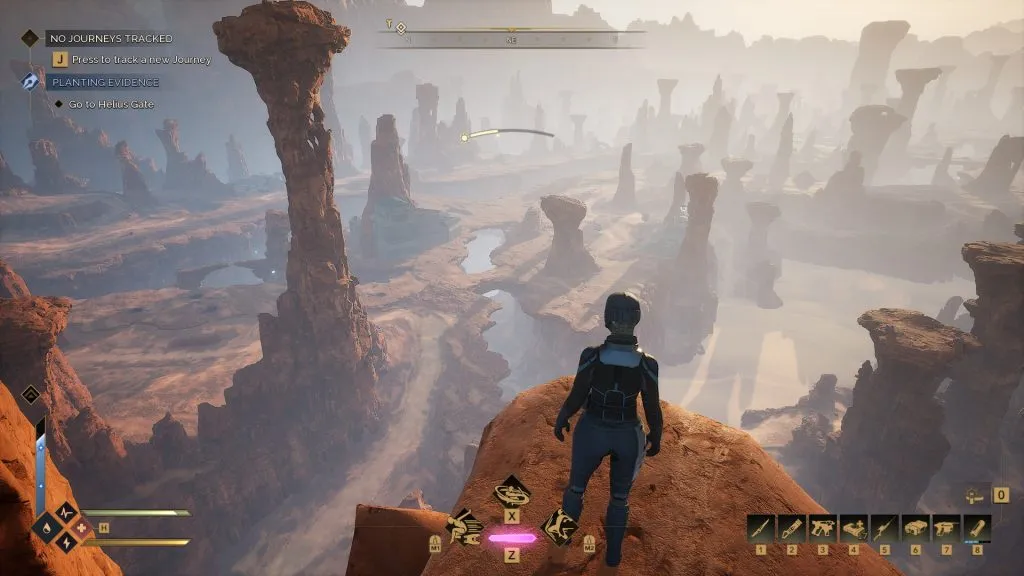
Visually, this game is a triumph, consistently delivering a stunning experience from its meticulously crafted cutscenes to the immersive real-time gameplay. While the predominant landscape is, naturally, the vast and unforgiving desert, the artistry truly shines when players stumble upon the more distinctive and intriguing locales. Discovering the twisting depths of bunkers carved beneath ancient rock formations, or encountering the haunting, irradiated husks of colossal starships, transforms the visual experience from merely impressive to genuinely breathtaking.
These moments not only break up the monotony of the sandy expanse but also showcase the developers’ incredible attention to detail and their ability to create truly memorable and awe-inspiring vistas within the Dune universe. This isn’t to say the landscape is always perfect. You will certainly find the occasional pair of outposts with the same interior or see some rocks floating above the surface, but for the most part, things look pretty fantastic.
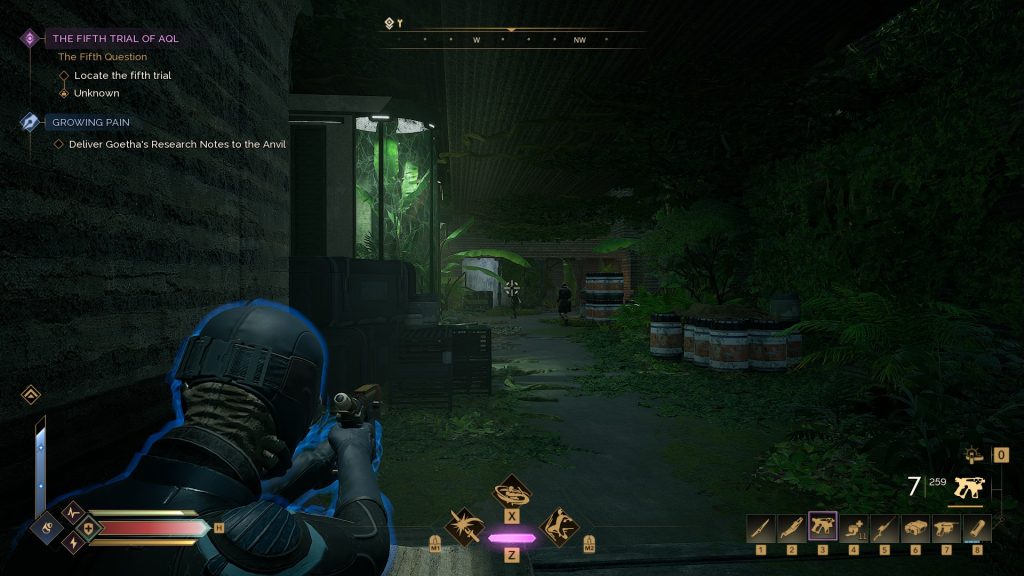
The visual design of weapons and equipment in Dune Awakening is undeniably one of its strong suits. The models are consistently stylish, effectively capturing the distinctive sci-fi aesthetic for which the Dune universe is renowned. From the hard edges of a dart rifle to the intricate details on a stillsuit, everything feels authentically part of Arrakis. However, this impression is sometimes dampened by a lack of variation as players progress through different tiers of the same equipment. Finally crafting that new sword becomes a lot less exciting when it looks exactly like your last one.
Survival
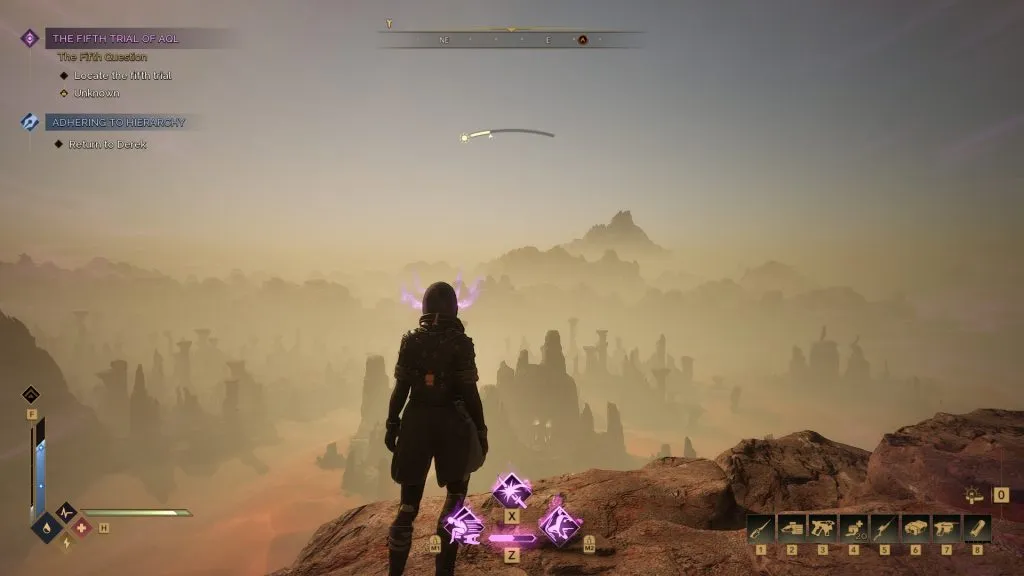
Dune Awakening is, at its core, a survival game. The gameplay revolves around desert survival, but not just any desert; this is Arrakis, a perilous alien world and the most contested planet in the known universe. This harsh environment presents significant challenges, the most obvious of which is the scarcity of water. Water is vital for survival, and every drop is precious. Both health and stamina are directly linked to hydration levels: better hydration allows for increased stamina, giving us more energy to climb and fight. On the other hand, if our water meter depletes, our health rapidly declines until the desert claims our corpse.
Survival on Arrakis hinges on learning the ways of the Fremen, who have survived Dune’s conditions for generations. One of the primary methods of acquiring water stems from their practice of consuming or refining the blood of their fallen enemies for hydration, a practice that may seem to border on cannibalism to outsiders, but will be the best way for you to stay alive. Seeking shelter from the relentless Arrakis sun during the day is just as critical, as direct exposure can lead to rapid dehydration and sunstroke. So, think like the Fremen. Take shelter in the shade or navigate by night, utilizing the cooler temperatures to aid in your travel.
Even with these practices, the most indispensable tool for any individual on Arrakis, be they Fremen or Maula, is the stillsuit. While a multitude of armor sets exist for defense against the planet’s many dangers, only a properly sealed stillsuit can efficiently recycle the body’s precious moisture into drinkable water. Of course, not all the dangers of Arrakis are rooted in reality, as clearly evidenced by the universal fear, or worship, of the mighty sandworms: Shai-Hulud.

If there is one aspect of this game that the devs absolutely nailed, it’s the Sandworms. These things are a real force of nature. Watching a worm breach off in the distance is magnificent, but also serves as a warning. Moving carefully between islands of rock is the only way to stay alive, as even a powerful sand bike won’t outrun a charging worm. These gargantuan creatures tunnel through sand like a fish through water and will eat anything that disturbs the open sands, be it a person or an entire city-sized spaceship.
There’s one more reason that every player should fear the worm above all else. Should you meet your end through conventional means, your inventory will drop, and your equipment will suffer damage, but it can all be recovered. However, if Shai-Hulud’s maw claims you, prepare to lose everything—your loot, your gear, and even your vehicle if it’s consumed. If you see wormsign, get to solid ground.
Crafting and Base Building
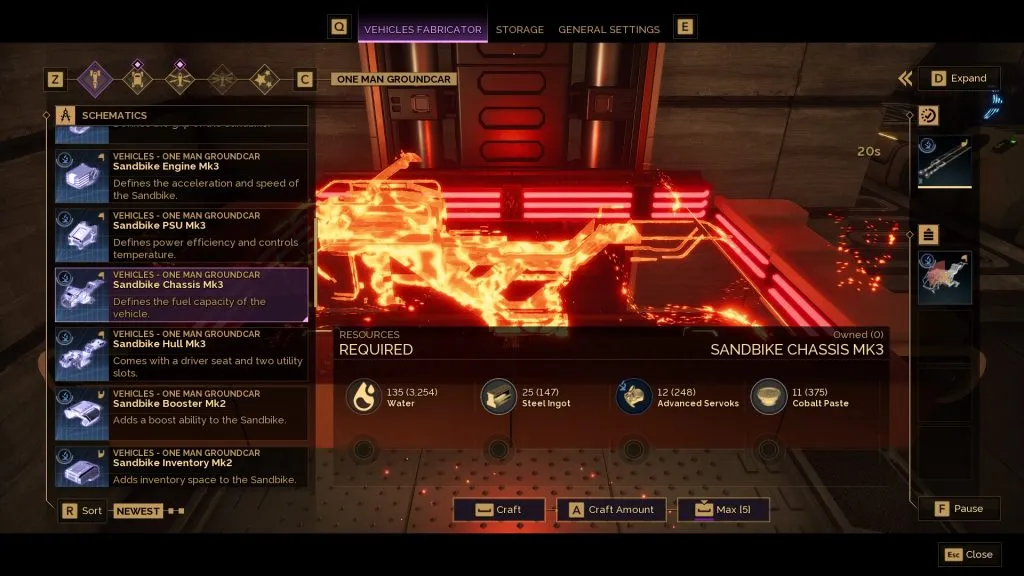
Putting that aside, base building and crafting new equipment are going to be the fundamental ways in which we progress. When it comes to shelter, we can build using a flexible base system. We start by placing a land claim device, which allows us to build almost anywhere—provided the location isn’t already occupied, of course. Finding a suitable base location can be challenging since many others are likely looking for the same thing. However, there are some awesome locations to build, and we saw tons of really creative player bases. Keep in mind, though, that this is also a game where you have to maintain your base (and pay Taxes) in real time or it will eventually decay and be destroyed.
Building or crafting anything requires a blueprint and materials. Blueprints are primarily obtained by spending intel points in the research screen. You earn these points by exploring points of interest, leveling up, or completing specific tasks. Additionally, unique blueprints can be found inside dungeons or purchased from vendors.

Collecting resources is straightforward; you can find resource nodes, gather items from the ground, or loot them from chests and defeated enemies. However, there is an interesting feature that enhances this process: when you scan a resource node, a guideline appears, showing you where to cut. This effectively breaks down the entire node for you.
The utilization of different harvesting techniques and resources keeps things interesting and unique to the world of Dune. For example, spice harvesting can only be accomplished by locating a spice blow in the environment and using a compactor to collect the precious grains into something you can pick up. But first, you have to locate a spice blow and hope you can get there before the worms or other players pick it clean.
Resource gathering can become a grind towards later parts of the game, but our equipment can be adapted to make this process much easier. Overall, all the advancements feel rewarding, even if their benefits aren’t immediately obvious. The tedious part might be transporting your resources back to your base, as getting around in general can be difficult.
Combat
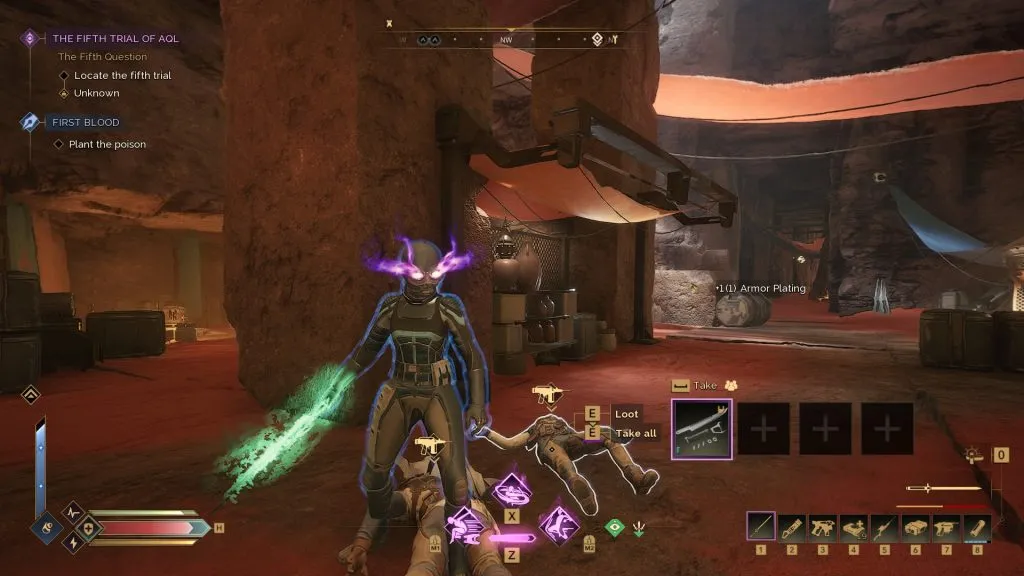
Not all materials can be sourced from the ground, and not all salvage will be unguarded. To find specific materials, complete quests, or compete for scarce, valuable resources, we will need to learn how to fight. The guns feel great to use; the sound effects are clear, and the aiming is precise. One significant aspect of Dune is the use of shields, and I’m glad the developers seem to have nailed this part of combat. These personal force fields prevent any fast-moving object from penetrating, making dart guns ineffective against them.
This encourages melee combat, which may be somewhat basic but is quite satisfying once you know what you’re doing, or the use of specialized anti-shield weapons like disruptors or the drill-shot. We can parry, dodge, and perform a series of light attacks or use a slow-moving heavy attack to penetrate shields and inflict heavy damage. While the enemy AI can be a bit simplistic, it appears to be rapidly improving with each update. They don’t fully understand cover yet, but they are getting better. Instead of just letting you attack freely, ranged attackers now retaliate with bash attacks or dash away.
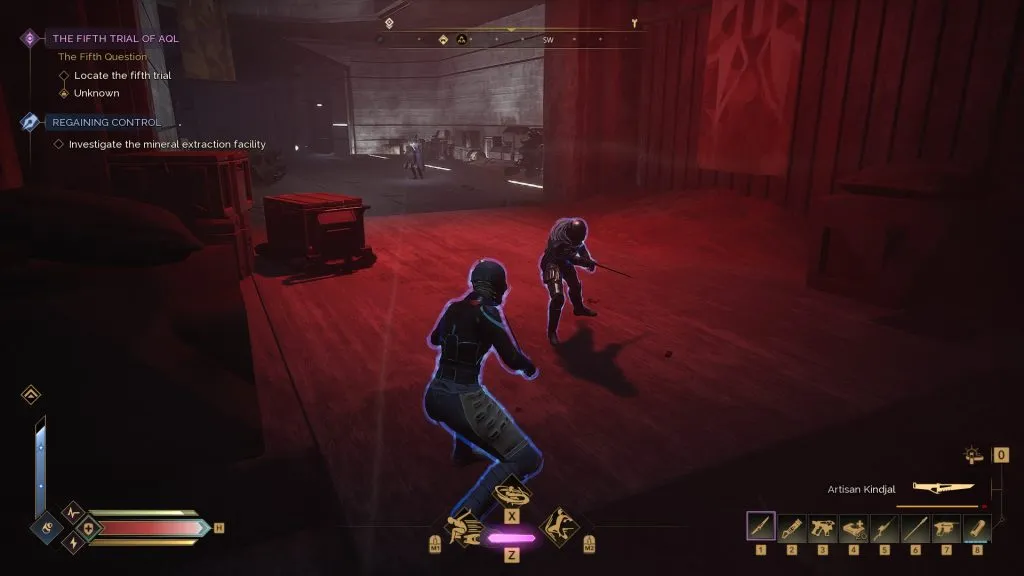
The other defining feature of combat that translates to both exploration and survival is the skill trees. Each time we level up, we earn a skill point that can be spent on passive boosts to various stats, such as blade damage, stamina recharge, or the amount of ore we gather while mining. In addition to these passive abilities, we also have access to active skills. For instance, we can deflect bullets with a sword, command enemies to ignore us, or deploy poison mines to protect ourselves. The game also offers various movement tricks, including jump pads, anti-gravity grenades, and a grappling hook, which create a dynamic mix of climbing, jumping, and grappling.
Multiplayer
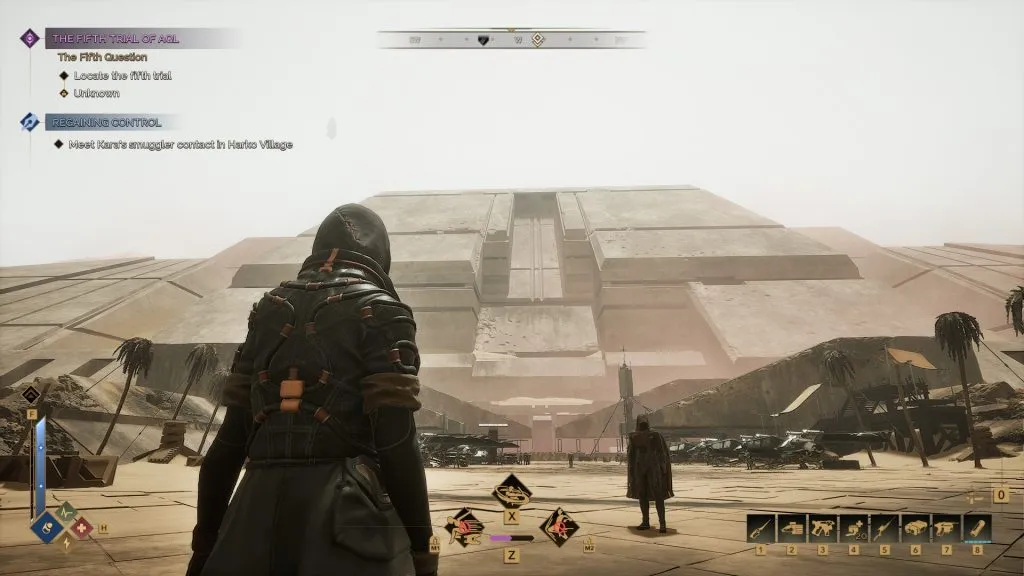
There are already some pretty massive battles out in the open PvP arena known as the Deep Desert. In this constantly shifting and extremely dangerous environment, players can compete to earn votes from the great noble houses in exchange for rewards and even decrees that affect the entire game, such as decreasing crafting costs or lowering player taxes.
During the course of the story, players have the option to choose a side in the war of assassins, declaring their support for either House Atreides or House Harkonnen. By earning favor with their side, players can earn faction-based rewards and eventually collect rewards from council votes. Of course, these rewards are only there for the victors, and this is a competition. Players not only have the option to create or join a guild, but are effectively barred from late-game events unless they are in a guild.
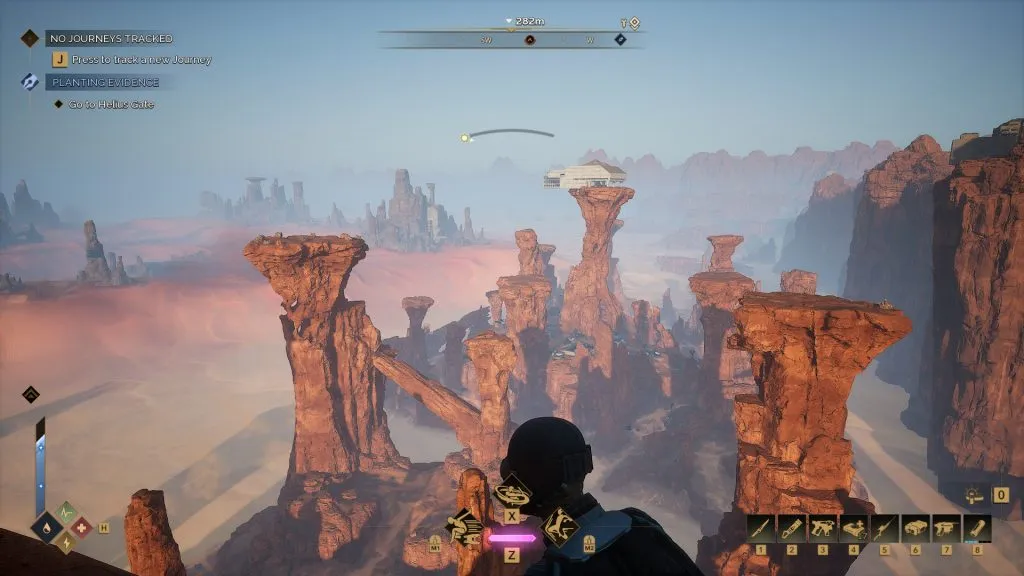
While the majority of the game can be enjoyed solo, players must be on a server with other players. Additionally, there are several locations in the static world map that function as PvP zones. For the most part, though, our experience with other players has been remarkably positive. Many bases include unlocked sections for other players to shelter in during storms, and while the global exchange lets us buy and sell items across servers, you can often just ask for what you need in a city, and other players will be happy to help.
The Deep Desert is a bit of a different story. This area is the premier PvP experience for Dune: Awakening, and despite Funcom’s use of Anti-cheat software, cheating and hacking are still rampant. Many high-level players and powerful guilds have expressed extreme frustration with the sheer number of cheaters ruining the experience, and though we haven’t experienced it ourselves, it continues to be a sore spot for the game.
Final thoughts on Dune: Awakening
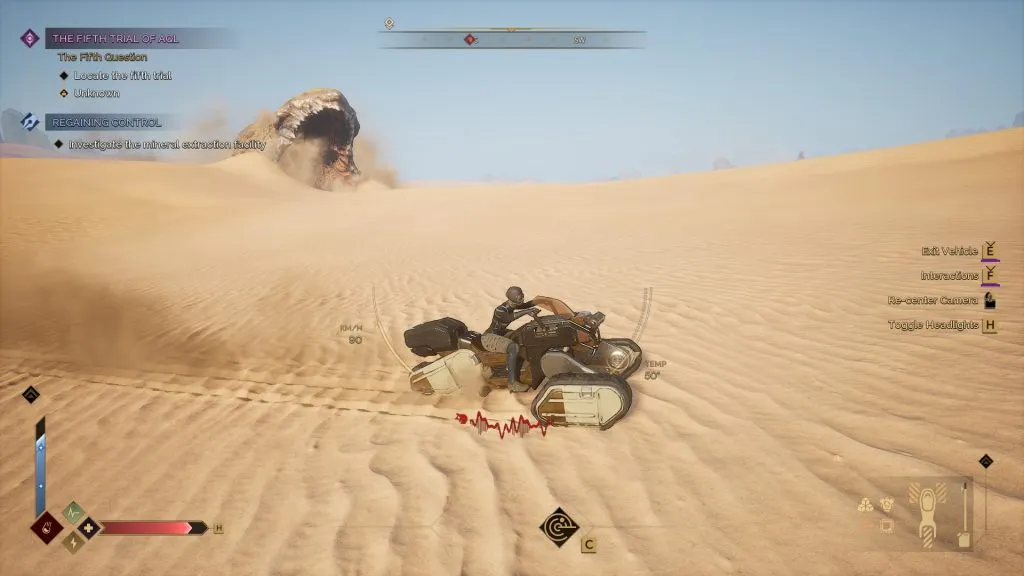
After MANY hours beneath the harsh suns of Arrakis, we have to say: We are pleasantly surprised by this title. Not everything is just the way we want it, and there are some major missed opportunities, such as the inability to ride sandworms or use the Fremen Sandwalk. However, overall, this version of Arrakis proves to be a remarkably lively and consistently enjoyable universe to immerse ourselves in.
Whether you love addictive survival games with unique mechanics or want a cool sci-fi adventure, whether you’re a longtime Dune fan or a newcomer to the series, Dune Awakening offers a massive and beautiful survival experience that feels both nostalgic and new at the same time.
